
 07424380227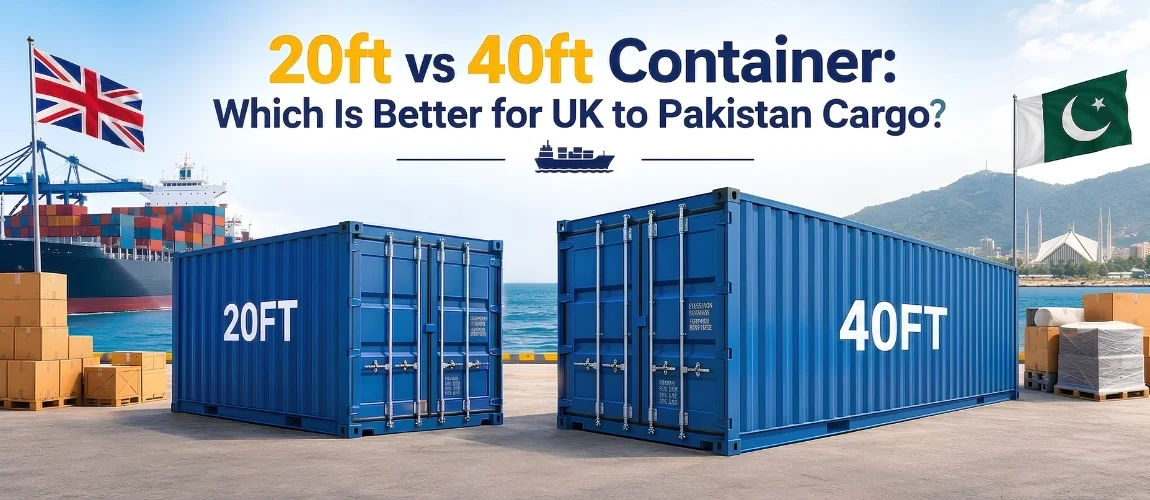
The choice of the right shipping container will make your cargo transport simpler for you. It will also determine how much your total shipping cost will be. Most customers in case of UK to Pakistan cargo tend to compare between 20ft and 40ft containers before booking. Both of the shipping containers are useful; however, they have different cargo needs. A 20ft container can be ideal for small or heavy cargo. A 40ft container is suitable for large and voluminous cargo. The best container for your needs depends on your cargo needs, budget and cargo shipping plan. There could also be a possibility that the most economical selection would not be the most cost effective at times when the biggest vessel still has available capacity.
What Is a 20ft Shipping Container?
One can consider 20ft shipping containers to be a convenient option for transporting small loads. They have a standardized design that allows them to be used internationally as a means of sea transportation. You can learn more about shipping container types and sizes from Maersk’s container guide. Their relatively small size allows their use in household relocations and transportation of commercial cargo. A typical 20ft shipping container will have approximately 33 cubic meters of internal volume. The exact amount may vary depending on the design of a specific container. Weight is another factor to take into account while planning your shipping. Some heavy cargos will be at the weight limit even before occupying all the internal volume. Heavy machinery, metal goods, tools, and equipment can be considered a good fit for such containers. This container can also be used for smaller household relocations. Such a container will be able to transport household items like furniture or appliances or boxes with personal belongings and other goods. Proper loading can increase your efficiency. Improper loading will cause unused space. For customers who have smaller shipments, this container can be a reasonable option.
What Is a 40ft Shipping Container?
There is much more area in the 40ft box than in the 20ft box. This is because the former holds a capacity of 67 cubic meters internally. It is helpful for moving large household and business items. Such items as sofas, beds, wardrobes, tables, appliances, cartons, and other pieces of furniture take up much space. It means that a 40ft container will provide you with enough room for your shipment. Companies can also benefit from using such a container in order to ship their larger shipments of stocks. Such items as retail products, packaged items, furniture, equipment, and supplies can be easily moved in a 40ft container. Increased size can make it easier for some customers to manage their shipments. However, increased size does not necessarily mean a better deal. You have to pay attention to your cargo weight and overall cost. It is better to choose a 40ft container if you need all its extra capacity. Otherwise a 20ft container might be a better choice for you.
20ft vs 40ft Container: Key Differences
In essence, the main distinction is related to the available space. A 20ft container provides smaller internal volume and compact loading area. A 40ft container provides twice bigger internal length and larger volume. Such characteristics mean that different cargos will be transported using different containers. A 20ft container will be perfect for transportation of heavy and small-volume cargos. A 40ft container will be better for transportation of bulky and large-volume cargos. Furniture represents an example that shows the difference very clearly. Several heavy pieces of furniture may be perfectly loaded into a 20ft container. A complete household with large furniture pieces requires a 40ft container. Commercial cargos also require your attention and consideration. The denser the cargo is, the sooner it will reach the maximum weight for a 20ft container. Light-weight cartons will fill a 20ft container till it reaches the maximum weight. The same thing is true about a 40ft container.
How Much Cargo Can a 20ft Container Hold?
The interior volume of the standard 20ft container is 33 cubic meters. The exact usable space will depend on the type of the container and packing arrangement. Weight is another significant factor that is considered in deciding on the weight of the cargo loaded. Heavy goods can weigh up to the maximum load before filling the available space while light goods can fill the entire space without weighing up to the maximum weight of the cargo allowed. This point is significant when it comes to UK to Pakistan cargo transport. Heavy machinery and metal goods may require the 20ft container due to weight while household goods can be dependent on physical volume. Large furniture can leave spaces when poorly packed. Flat packed furniture can make use of the space efficiently. Standard cartons can also create a more organized loading arrangement. One should create an inventory before booking a container. Counting the number of boxes and measuring large household goods is necessary. Estimate the weight of the heavy products too.
How Much Cargo Can a 40ft Container Hold?
Space usually occupied by a standard 40 feet container is 67 cubic meters. It is perfect for larger cargos. Such a container can contain quite a lot of items. Big sofas, beds, wardrobes, cabinets, other household appliances and boxes can occupy much space. As a result, a 40ft container will give more space to all of these items than a 20ft option. Business clients will also be able to use the container more efficiently due to its bigger volume. Customers can pack retail goods, packed products, furniture, supplies, and equipment into it. This is a good solution if one 20ft container will not be enough to accommodate all of your cargo.Do not forget about weight limitations. Although you have more space physically, it does not mean that you have unlimited weight. Sometimes heavy cargo can reach the allowed weight limitation even before filling the whole space inside a container. The road transportation laws in the UK and Pakistan can also be applied to the total weight of the cargo.
20ft vs 40ft: Which Is Better for Household Moving?
The selection of the appropriate container would depend on the size of the household. A smaller household would use the services of a 20ft container, while a larger house would require the 40ft container. First and foremost, one has to consider his/her furniture, which includes sofas, wardrobes, beds, dining table, cabinets, etc. These items take up a lot of space. Appliances from the kitchen can contribute to the total volume of the household items too. There is an additional requirement of storage space for the cartons and personal belongings. For those who have a limited number of cartons, a 20ft container can work out well. For those who have multiple rooms full of furniture and personal belongings, a 40ft container may suit better. The 40ft container provides you with extra space during the loading process. There is no need to squeeze each and every item into a tight space. It can protect your furniture and fragile household items in the process. But this does not mean that one must go for a 40ft container without doing a little calculation of one’s own. Unutilized space can raise the cost of shipment.
20ft vs 40ft for Commercial Cargo
It is important to think strategically before planning a commercial cargo shipment because every cargo shipment will have an effect on your business expenses. A 20ft container will be suitable for shipping commercially produced and dense cargos. Cargos such as machinery, metal items, tools, equipment, and industrial cargo may be shipped in a 20ft container. A 40ft container will be more suitable for cargos which need more space. One of the easiest examples for this situation is retail cargo. A business may have the need to ship hundreds of cartons at once. Cartons can easily fill a 20ft container. Therefore, a 40ft container can provide you with enough space to fit all the cargos in the same container. Moreover, it will help you to avoid having two different shipments with different containers. This will be more convenient for companies with a large volume of cargo transportation. It will also be helpful for regular exporters since they can plan their shipments better. They can reorganize their cargo packages for future cargo shipment purposes. Instead of choosing the biggest container, they should aim to use the best space with the best prices.
Is a 40ft Container Always More Expensive?
It is quite normal to pay more in freight charges for a 40ft container than for a 20ft one.This does not always mean that it will necessarily be too expensive. Freight costs can be determined by several criteria. For instance, your carrier, route, point of origin, destination point, time of year and type of shipping can all affect the price. Also, port fees and additional fees for other shipment aspects can vary from time to time. In many cases, the difference in the cost of container types may be less significant than initially expected. It is particularly relevant when it comes to large amounts of cargo. If, for example, your shipment requires more than one 20ft container, two smaller containers may result in additional costs related to freight and handling. In such a case, one 40ft container will serve you better. You will have to compare the two options yourself. Request from your shipping company a full quotation of the price for both of them. Do not look at only the ocean freight rate.
When Should You Choose a 20ft Container?
A 20ft shipping container would be an ideal choice for people who have small volumes of cargo. It is also suitable for those people who have heavy cargo that requires no physical space. Those individuals who have to move to a new home but their stuff is few in number can opt for a 20ft container. Companies having compact products can also make use of this type of container. It can save you money by not buying additional space that you cannot use. In case your cargo consists of machinery or any heavy product, make sure of the weight of the cargo since your 20ft container might exceed the weight limits before filling all the space available.
When Should You Choose a 40ft Container?
The 40 ft container is the most appropriate for huge house moves and mass volume transport. This is because it offers a lot of space for heavy furniture and bulky cargo. The full household relocation can take advantage of this extra space. Big businesses having large orders can find this useful. It will prevent you from needing many smaller containers at once. The extra space is also useful when placing your cargo in the right order. This is especially so where the cargo needs careful handling. Extra space is only valuable where you really need it. Where your cargo only occupies part of the container, there is another cheaper option that you can use. You should therefore gauge how much your cargo takes up before making any bookings. This can be in terms of number of boxes and sizes of furniture. Where it is commercial cargo, you have to consider both volume and weight.
Which Container Is Better for UK to Pakistan Shipping?
There is not one correct response when it comes to whether 20 ft or 40 ft is the right container size for you. It is necessary to take into account your cargo and budget. There is always an option for the 20ft container to be used for either small household relocation or for transporting bulky commercial cargo. Meanwhile, the 40ft container will work well for larger houses and for high-volume shipments in the business world. The shipping of containers from the UK to Pakistan is a long journey, which means that pickup at your UK address and all the following steps (including port handling and ocean freight services) are a part of the final costs. Delivery of your cargo in Pakistan is also included in the expenses. There might even be customs requirements, which means that taking only container prices into consideration is not enough. Get a full quotation for your shipment and tell your supplier about the number of boxes you have, dimensions of bulky furniture and items and any machinery or other heavyweight cargo you want to ship.
Compare Your Cargo Before You Book
The cargo itself should dictate the size of your container, not your personal preference of getting more space. Start with compiling an initial inventory of what you plan to ship. Divide your furniture, appliances, cartons, machinery, and equipment into separate groups. Measure your larger pieces wherever possible. Count the number of cartons you have, estimate their total volume. Weigh your heavier products if necessary. This information will help you make a comparison between the two sizes, which can also be used by your shipping provider to make a more appropriate quotation. Do not rely on your estimates and assumptions only; you need professional advice to strike a compromise between two opposite sides. The perfect container should provide sufficient space for your cargo, but there shouldn’t be much wasted space either. Such considerations play an important role for any shipment, whether you move household or commercial cargo. In addition, it is important if you ship your cargo from the UK to Pakistan.
Final Thoughts
Selection between the two becomes easy when one is aware of the cargo. A 20ft container may be used for small cargoes and heavy ones. A 40ft container may be used for large cargoes with a higher volume. However, neither container is best for every customer. You should consider cargo volume, weight, budget and your delivery needs to select the right container size. Household clients should take into account cargo types like furniture and number of cartons. Commercial clients should think about the volume and weight of their cargo. After that, you should calculate the total costs of both containers. A trustworthy service of UK to Pakistan shipping will help you to do it. It will analyze your cargo and tell you what container will be appropriate for your case. Moreover, it will give you an idea about your total shipping cost. Neither the largest container nor the cheapest one may be suitable for every case. What matters most is that your cargo will have enough space within a reasonable total cost.